As an IT business grows, there will be a time when the engineering/product team needs to expand to keep up with the demand for new functionalities, scalability and agility.
While it may seem like a logical solution to go on a hire frenzy and multiply the team size the reality is that this strategy can and eventually will backfire, after a few years, when the bubble blows.
The 2023 big layoffs of Meta, IBM, Dell, Microsoft (and I could go on forever) are the hard evidences of the point I’m trying to make.
In fact, adding more people to an engineering team doesn’t necessarily lead to a linear increase in output, and in some cases, it can even decrease the overall productivity.
No, I’m not talking of some Pareto-backed bullshit that some people like to shamelessly think and, more serious, share:
“If you fire 80% of your workforce you are still fine with the 20% left”.
Hell no. That’s not true.
But anyway, back to my point.
The point
Something that needs to be taken into consideration is the productivity factore inside the team. I like to visualize it and valorize it as a score that goes from 0 to 1.
Let’s assume that when 4 of our engineers are working together, the output is 1, even if I think that the best teams often reaches 0.7 at most.
When the team is doubled to 8 engineers, the expected output would be 2, right? Nope, wrong.
Not only it won’t double, in some case it won’t even increase by 50%.
In fact, the output in most cases and after the initial re-assessment period, will still be somewhere between 1 and 1.5, but why?
The reasons
One of the reasons why doubling the engineering team doesn’t lead to a proportional increase in output is… (drumroll please) the onboarding process.

Each new member of the team needs to get acquainted with the new colleagues, get in touch with the company’s processes/policies, and become familiar with the products they are working on.
This process can take a considerable amount of time, and it can take even longer if the company is heavily using custom tools, new technologies or methodologies that the new hires are not familiar with.
Providing clear documentation, a buddy/mentor to pair up with for the first weeks, scheduled check-ins and expected goals (the smaller the better) are all tecniques to lower the effect of the onboarding process on the overall productivity of new team members.
This is the factor that most influences the output in the first period of your size increment.
Another factor to take into account is: team building.

A cohesive team is more productive than a group of individuals just working together. When the team grows, it can become more challenging to maintain a sense of camaraderie and teamwork.
New members may take some time to integrate into the team, and it may take longer for the team to reach optimal performance levels.
Finding personalities that fits well together or in an existing team is never easy but having clear roadmaps, objectives and careers paths often helps.
There will also be a time where friction rises within the team.
Even the best teams can experience it; it can happen due to differences in opinions, work styles, communication issues, strict deadlines or project contraints.
The more people on the team, the higher the likelihood of friction occurring and when friction levels increase, productivity will surely decrease, therefore the output of your team won’t grow linearly with the number of its members.
Well, there is no easy way to enable team building and diminish friction, surely a good hiring process that takes into account attitude and personality along with technical skills is a good starting point but, more often than not, insufficient.
Creating a sense of shared responsibility/merit, handling conflicts or criticism in an open and constructive way (especially when management is involved), listening and giving space to your tech peeps… These are all fundamental steps and there is no easy recipe.
Now a big one (pun intended): size.
An engineering team with 10 people is too big and should be split in two 5-people teams. I said what I said and you can’t change my mind.
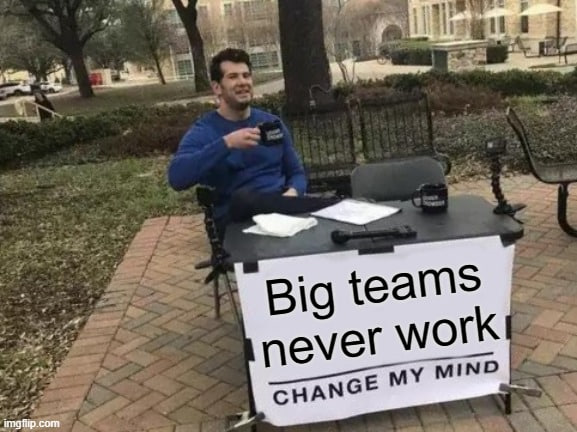
First of all: engineering managers and team leaders are human beings, uncapable of duplicating. They have to handle 1–1 meetings, a constant research of issues + solutions, coaching, discussions about objectives, priorities and delivery. There is a lot on their plate, help them by sizing your team accordingly.
Your team is made of human engineers too (at least until AI will take over). They need to create bonds, having relationships with each other and communicating.
Having 4/5 close colleagues is manageable but, on the other hand, working with 10+ people on the same team, everyday? Definitely an additional challenge you don’t want to give them.
“Divide et impera”, Romans were right all along.
The solution
Jokes on you! There is no one-fits-all solution in IT, but summarizing, what can companies do to handle these problems?
- Having a good management that can properly integrate new team members and handle the entire group;
- Keeping the groups small;
- Hiring people with experience in the same technology stack, culture, or industry;
- Create a healthy environment where communication is key;
- Reduce onboarding time with documentation and processes;
Alternatively, one can try outsourcing to other IT companies that already have well-oiled teams who can accelerate your company growth.
These companies have already gone through the onboarding, training, and team building processes, so they can deliver high-quality output from day one.
No, I don’t mean big consulting firms who usually work by numbers and not by quality, often resulting in high prices and low-quality deliveries.
I mean smaller companies relying on quality and optimization, companies that hire in a sustainable fashion and value people above all, clients included.
That’s why I say that doubling the engineering team numbers won’t (linearly) double the output.
Title is a clickbait, as always!
Follow me here, hit that green button!
Feel free to comment, share and tag me to discuss.
You can follow my other social media (here).
Want a call with me to chat about your engineering issues and check what my company can do for you? Hop on this link.
See you next time!
Originally published on blog.mb-consulting.dev.